
I wrote four months ago about the strange, nonsensical proposal from a technology company, Reflect Orbital, to put mirrors in space to reflect sunlight onto the Earth at night, which customers could use to power solar panels to generate electricity. The cost: $5000/hour for the light of one space mirror. As I calculated in my earlier post (and shared with my Physics of Energy and the Environment class), the maximum value of the electricity that could be generated by one space mirror, perfectly capturing sunlight and focusing it onto a solar panel is $72/hour. In other words, normal terrestrial electricity is about 70 times cheaper than space mirror fees. The customers have to supply their own solar panels, of course. You might say: they have the solar panels anyway, why not pay $5000/hour to get some nighttime use from the array? That $5000/hour could instead buy a lot of extra panels for normal daylight generation, or batteries to store excess electricity, or cooling to make the existing panels generate more power, etc.
One would think that the glaring senselessness of the proposal would be so apparent that the scheme wouldn’t go anywhere; perhaps it was just a thought experiment or a way to grab attention. But no: Two days ago, the New York Times published an article, F.C.C. Approves Test of Space Mirror to Light Night Sky Despite Outcry (July 10, 2026; Link). The article notes that many people are upset by the light pollution; “the light from the mirrors could distract airplane pilots, wreak havoc on astronomical observations and interfere with circadian rhythms, the light-and-dark cycles that help people, animals and plants know when to wake and sleep, to bloom or to migrate.” This is a valid concern, though we already live in an environment with orders-of-magnitude more nighttime light pollution from standard sources. Annoyingly, though not surprisingly, the New York Times says nothing about the actual physical infeasibility of the proposal. Their earlier article at least had relevant quotes from scientists; this one doesn’t.
In my earlier post I sketched the amount of electrical power that would be generated by the proposed 3600 square meter space mirror, given the density of solar power (about 1 kW/m2) and the efficiency of solar panels (20%, constrained to at most 33% by laws of physics). This is 720 kW, or about $72 of electricity every hour. I noted in the post that, pathetically small as this is, in practice it will be even worse due to other fundamental issues, a key one being that “the light will spread out as it travels from the mirror to the earth, covering a large area with quite dim light.”
It’s even worse than you thought
Here, I’ll elaborate on that spreading. No matter what sort of mirror or lens you make (and go to the trouble of installing in space), the universe constrains how tightly it can focus light. The principle is known as “conservation of etendue“, and it has been known in various forms since the 17th century. This isn’t esoteric physics; it follows (equivalently) from principles of optics or of thermodynamics. There’s even an excellent “What if? (xkcd)” article about it! There’s also an excellent physics stackexchange post that specifically applies the concept of etendue to Reflect Orbital’s space mirrors. What I write below about spreading light is definitely not original. (If you read this, “TJM“: Thank you!)
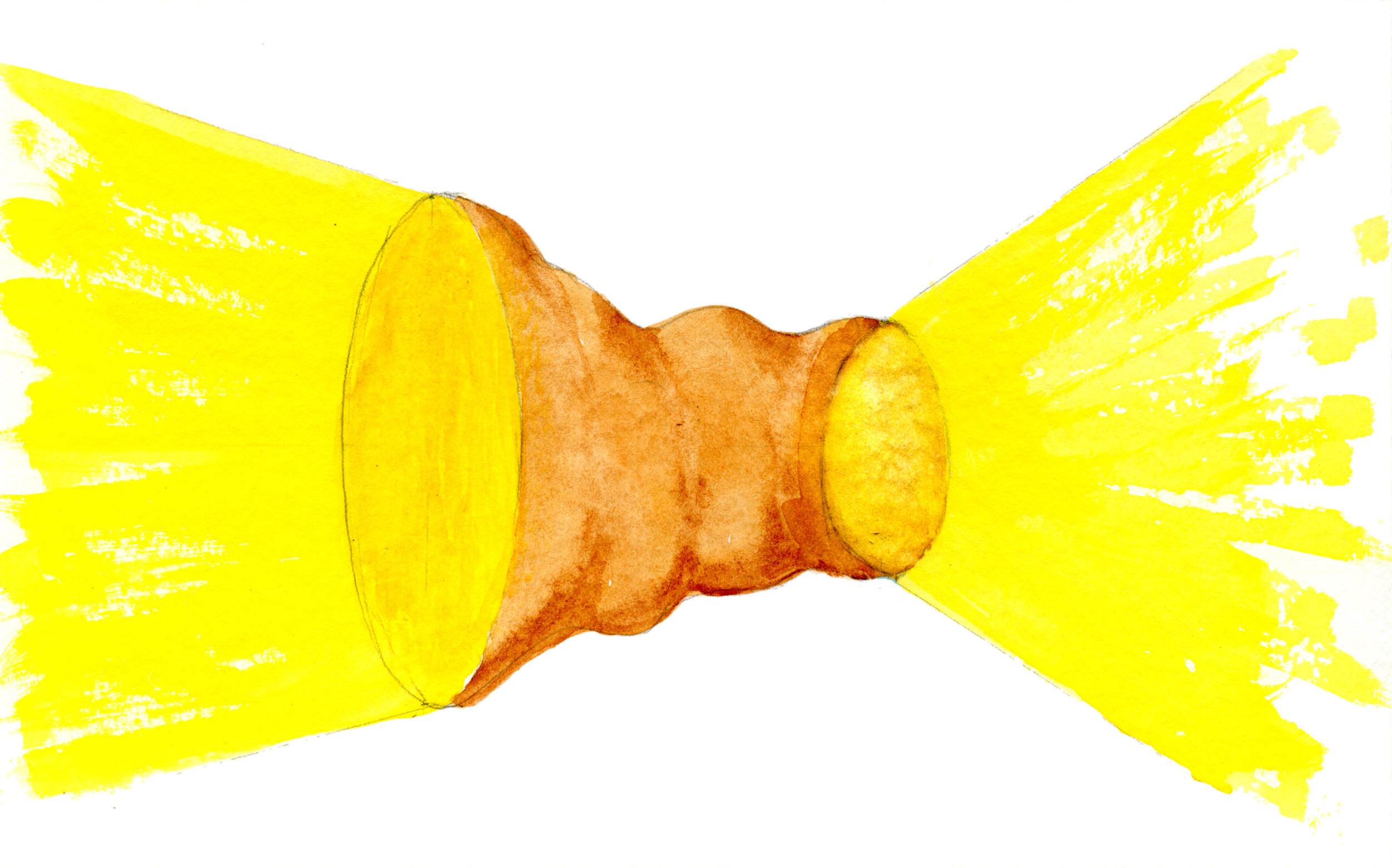
Imagine you have some optical device, like a mirror or a set of lenses, that collects light spanning some range of angles using an aperture of some size, and then emits light spanning some range of angles using an aperture of some size. Conservation of etendue dictates that the product of output angle x area must be at least as large as the product of input angle x area. At best, they can be equal. In the illustration above, the squiggly thing in the middle is whatever optical system one makes, whether a simple lens or something full of complicated components. The light on the left is collected over a narrow range of angles by a large aperture; the light on the right exits through a smaller aperture over a wider range of angles. (Technical note: It’s the product of solid angle and cross-sectional area that’s conserved. There are interesting connections between this quantity and entropy.)
For a mirror, the input and output areas are the same, so the output spread of angles must be at least as large as the input spread of angles. For a mirror collecting sunlight, that input spread is determined by the apparent width of the sun, and therefore the ratio of the sun’s diameter (dsun) to the distance to the sun (Lsun):
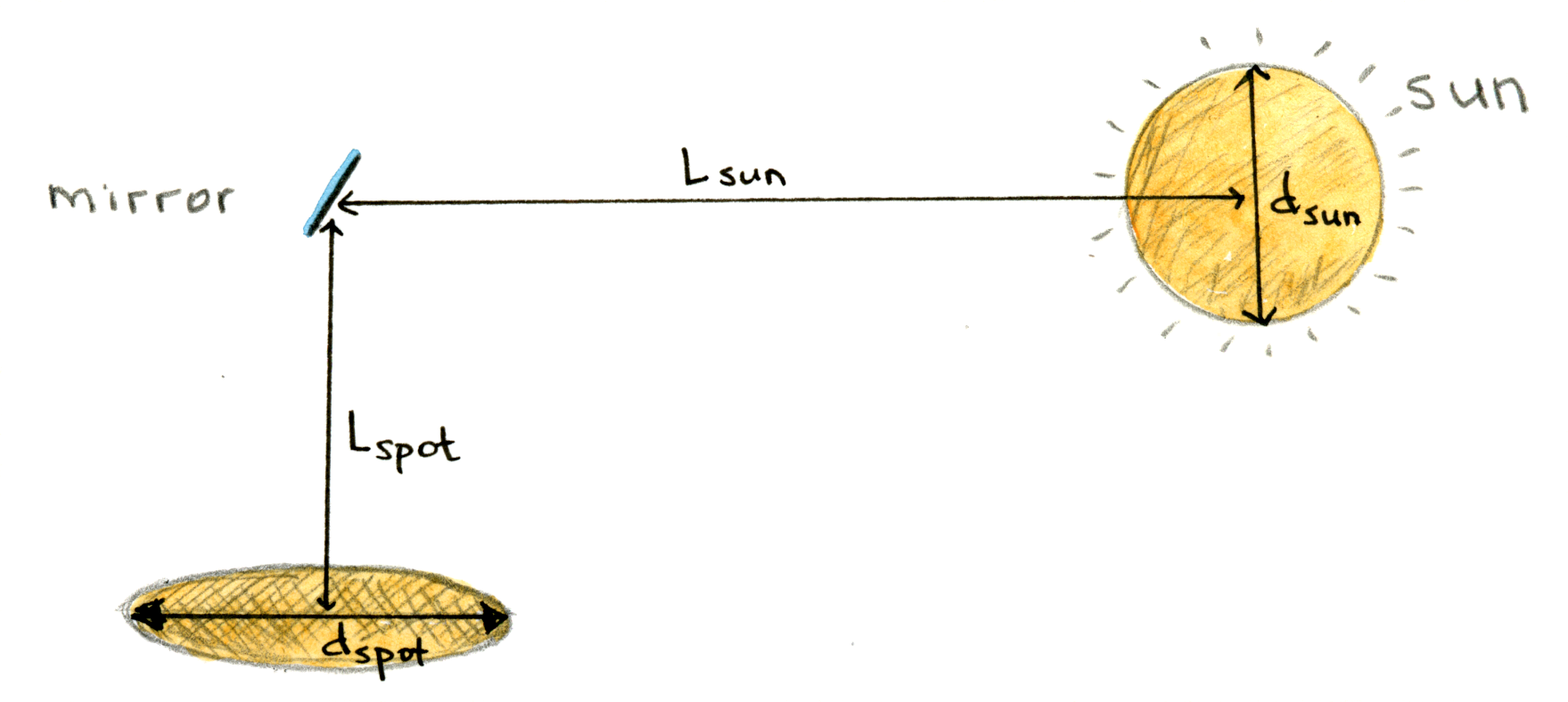
The output spread is similarly related to the diameter of the spot on earth (dspot), and the distance to the spot (Lspot).
Therefore, dspot / Lspot must be at least as large as dsun/ Lsun.
In other words, the diameter of the spot on earth must be at least as large as Lspot x dsun / Lsun .
We know the values of all these parameters: Lsun = 150 x 109 m, dsun = 1.4 x 10⁹ m, and the distance to the mirror, i.e. the height of its orbit, the company tells us is 400 miles (6.4 x 10⁵ m). The spot must therefore be at least 6400 m, or 4 miles, in diameter. The company agrees; from the recent New York Times article, “The mirror would bounce sunlight to illuminate a circular patch about three miles wide on the Earth’s surface.” (I am surprised by their honesty.) It doesn’t matter if one makes the mirror flat, convex, concave, or some complex shape; a four mile spread is unavoidable.
A 3600 square meter space mirror would, at best, dilute 3600 kW of power over a circle 4 miles in diameter, giving a power density at our hypothetical terrestrial solar panels of 0.0001 kW/m2, or 0.1 Watts per square meter. That’s 10,000 times dimmer than noon on a sunny day, and about 100 times brighter than moonlight.
Is 0.1 Watts per square meter better than nothing? No.
But, you might say, 0.1 Watts per square meter is better than nothing. No, in fact, it’s not; it is nothing: solar panels (photovoltaics) won’t generate electricity with such little light input. The resulting currents will be dissipated by inherent resistivity in the device, and the electronics necessary to couple the electricity to other circuitry (inverters, for example) draw far more power than 0.1 Watts per square meter. In fact, 50 Watts per square meter is often stated as a lower limit for the irradiance that can sustain a solar panel. Even if pushed to 10 W/m2, that requirement is 1000 times greater than what our space mirrors could provide, even in the best case.
The notion of solar power from Reflect Orbital’s space mirrors is even more idiotic than it seemed from my first post.
What about non-photovoltaic applications of reflected sunlight? The company notes in the article that the light from space mirrors could “provide light for rescue workers and illuminate city streets.” This is also nonsense. Light is cheap. Developing portable, low-cost light has been one of the great technological triumphs of the past few centuries. As an Our World in Data post shows, “The price of lighting has dropped over 99.9% since 1700”. There is no conceivable scenario by which it makes sense for “rescue workers” to pay $5000/hour for dim Reflect Orbital light rather than paying for spotlights and flashlights, which in addition to being vastly cheaper are brighter and directed.
Once again one has to wonder whether Reflect Orbital’s scheme is a scam, if the space mirrors are just a gimmick to draw attention before pivoting to a goal that actually makes sense, or if the company and its investors are genuinely ignorant of basic physics. Sometimes when I make comments like this, I get a reply that the company’s plans must make sense, because if they didn’t investors wouldn’t invest in them! The illogic is remarkable. (It would be interesting to live in a magical world in which Homo economicus were perfect and equilibrium were reached immediately.)
Perhaps it’s most charitable to assume that Reflect Orbital and its investors are ignorant of basic physics. I have written to them to offer my consulting services. I look forward to helping!
Today’s illustration…
I’ve spent perhaps 100 hours over the past few weeks on models, data analysis, and simulations of zebrafish behavior. This reminds me that though my lab has worked with zebrafish for over a decade, I’m still not very good at drawing them. I thought I’d practice making a very quick freehand zebrafish painting.
— Raghuveer Parthasarathy, July 12, 2026


Raghu, you might enjoy Isaac Asimov’s story “Reason” which is one of his stories in the collection “I Robot”. In involves beaming massive amounts of energy to the Earth. Asimov’s books are why I went into science.
I read a lot of Asimov when I was a kid! (I’m sure I read this story, though I have no recollection of it…)
There is a defense application, though I’m not sure I can see the value to the US DOD.
If you illuminate a 4-mile-diameter spot with something an order of magnitude brighter than moonlight, you prevent the enemy from moving through it at night undetected. String a few together and you might block off a choke point.
Thanks — that’s an interesting idea I hadn’t thought of! Two issues come to mind: (1) I would think that IR / night vision cameras are good enough to detect people at night without illumination, and (2) One would have to be repositioning the mirrors pretty quickly.