

How many out-of-state (non-Oregon-resident) students are there at the University of Oregon (UO)? This is an easy question to answer: about 9000, or about 45% of the total undergraduate student population. (Source; select “Class level”.) This is high but not unusual for similar public universities; as I plotted a few years ago, we have company in the 40-50% range:

As noted in that earlier blog post, the fraction of out-of-state students doesn’t correlate well with state funding, but nonetheless the tuition income provided by non-resident students is crucial for keeping my university, and others, afloat. (Out-of-state tuition is about 3X in-state tuition.) Our attractiveness to these students, and the number that enroll, are therefore carefully scrutinized.
How many of each year’s first-year, newly enrolled, students at the University of Oregon are from out-of-state? This data is harder to track down; I stitched together a handful of sources before getting data from a presentation by UO student services, which I’ve plotted below. Note that “2024” refers to the 2024-2025 academic year, “2023” to 2023-2024, etc.
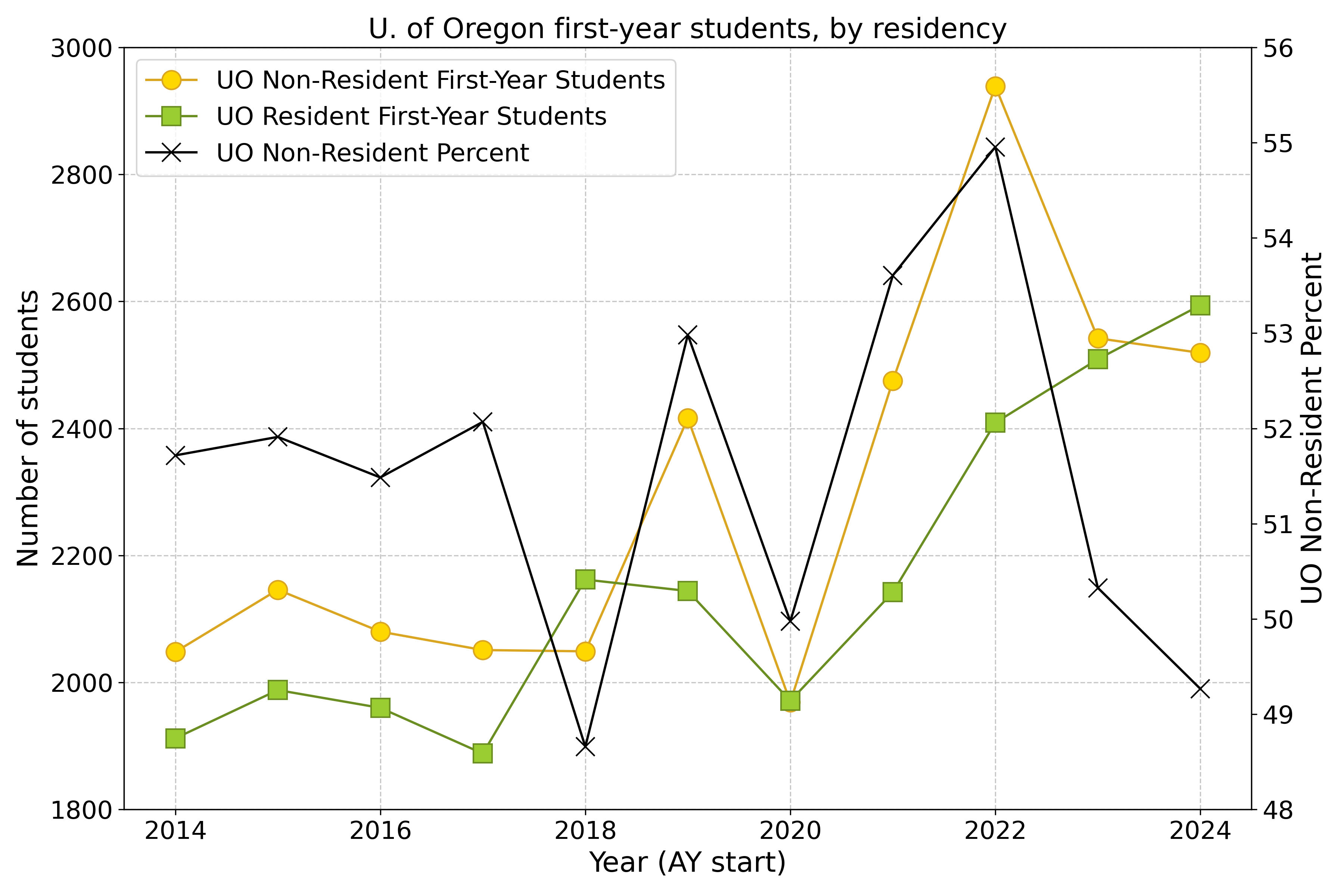
A notable feature is that the fraction of incoming out-of-state students is often over 50%. The conventional wisdom among many is that 50% is a ceiling, above which we risk making our state legislators angry. This is clearly not the case, however. (At least, not as a hard ceiling.)
Let’s suppose, dear reader, that you were a university administrator in 2023 tasked with predicting the number of out-of-state students who would enroll for 2024. Since out-of-state students bring precious income, the university is undoubtedly trying to increase non-resident enrollment, but this is not easy to do. What would your prediction for 2024 be? Maybe a 10% increase, to 2740? Maybe one might hope for a year like 2022, treating that as a sustainable datapoint and not noise: 2939. Surely not a higher number than this.
The oft-repeated news from Fall 2024 was that our university was in dire financial straits since the actual out-of-state student enrollment was far lower than targeted. The target: 2,984 students! Yes: the projection was a 20% increase on 2023, and higher even than the 2022 high water mark. The actual out-of-state enrollment was 2,536, almost identical to the year before.

If I fail to find a pot of gold on my way home, I can’t claim to have lost a million dollars; it would be absurd to expect the windfall. Yet, statements from our chief financial officer to our board of trustees (page 4), to the news media), and to faculty and staff imply that some perfectly reasonable target of out-of-state students wasn’t achieved, hence the university is surprisingly cash-strapped.
The projected enrollment and its impact on our budget is especially important because this has been a chaotic period at the University of Oregon. Of course, it’s a chaotic time now at every U.S. university, as universities are generally under attack by the federal administration and, even more bizarrely, the federal science funding that underpins nearly all research conducted at universities is under threat. In addition to all this, though, we have our own local chaos: Just over a year ago, we narrowly avoided a graduate student strike, and about six weeks ago, we narrowly avoided a faculty strike. Right now, we are in the middle of a strike by the undergraduate student workers union. Budget woes are already present: in many departments, graduate teaching assistant positions have been cut, and faculty hiring curtailed.
In discussions of all of these issues and crises, especially involving faculty and graduate students, two broad topics are ever-present. One is the increase in administrative and non-instructional positions. Another is the budget landscape of the university. For the latter, it’s important to have a transparent, competently constructed picture of where we are and what we might expect.

I’ve posted above, free of charge, a prediction of the 2024 out-of-state enrollment, with error bars, from a simple linear regression to the 2017-2023 data. There are undoubtedly better models to be made (though I can easily imagine overfitting), but at least here the method and the uncertainty are transparent. The actual enrollment number is smaller than the linear regression would predict, but not by a lot.
It is, of course, hard to predict the future. What annoys me about all the university’s claim of shockingly low non-resident enrollment, though, is that (i) projections are given without any statement of their uncertainty; (ii) projections are given without any explanation of the methods that generated them; (iii) as far as I know, there’s no accountability for failed projections — our chief financial officer who announces all these things continues to make over three times my salary; and (iv) our board of trustees doesn’t care to ask about any of these things.
I’ll end with my low-cost (i.e. free) prediction for next year’s enrollment. Linear regression for 2017-2024 gives 2789 +/- 199 out-of-state students for the 2025-26 academic year. I’ll try to remember to check the actual number six months from now!
Today’s illustration…
A killdeer. I traced the outline from this photo, so it was just an exercise in painting.
— Raghuveer Parthasarathy, May 5, 2025
 The Eighteenth Elephant