
Many days are a blur of activity, but the Thursday before last (October 10, 2024) my pinball-like bouncing from one task to another, often with little connecting them other than being part of my job, seemed slightly more ridiculous (or interesting) than usual, so I wrote things down.
Events
Start the morning (breakfast, coffee) revising a paper, responding to reviewer comments. This included pasting p-values on figures while gritting my teeth. Anyone who thinks seeing p-values displayed on a plot, when effect sizes, standard errors, and the individual data points are clearly shown, shouldn’t call themselves a scientist, but I won’t write that in my response.
Bike to campus.
Skim the paper for today’s science teaching journal club.
Attend our science teaching journal club. About 20 people are present — a mix of graduate students, instructors, and faculty that makes it especially worthwhile. The paper involves exploiting undergraduates to help run classes — I’m somewhat appalled — but the discussion is mostly about other aspects of teaching in teams, and is informative.
Discuss analysis of zebrafish swimming behavior, which I’ve been writing code for, with a postdoc in another group. I make a list of analysis tasks and know that I won’t get to them soon, despite their being interesting.
Attempt to figure out how to use a pair of hydraulic lifts to move an optical table, together with a grad student. We are unsuccessful.

Drop by the “coffee lab” which twice a week dispenses small amounts of coffee, for free, and at which people gather. There’s a special guest today (not me), so for the first time in my experience, they use their $20,000 espresso machine, shown below. Now I can say I’ve had coffee from a $20,000 espresso machine. It was ok. (Not very foamy.)

Prepare for class, making a nice example of Fourier analysis of images.
Hurriedly eat my lunch.
Go to a colleague’s class to perform a peer teaching evaluation. I am reintroduced to special relativity, and I re-realize how amazingly simple it is.
Receive an email that my students figured out the hydraulic lifts and moved the optical table! I am impressed. One student was briefly trapped between the table and the walls. I go check things out and inform campus facilities that they can access the ceiling, which was our motivation for moving the table. (We’ve had dripping water, which is frightening when one has a table full of optical components forming a home-built microscope.)
Chat with a undergraduate student in my lab about data on bacterial growth. (Thankfully, our bacteria are growing. For months, this was not the case.)
Frantically prepare a bit more for class.
Teach class. This is my Image Analysis and Related Stuff class. Part of today’s session includes showing people that best-fit parameters for lines, planes, etc., can be determined analytically, not merely by numerical search, which half the class (mostly grad students) were unaware of. Everyone should know this — it’s simple, elegant, and important. The detour goes well. The main topic of Fourier analysis of images is a bit rushed, but the students seem to get it. It helps that nearly everyone has seen Fourier analysis before, at least a little bit.
Ended class 5 minutes early to make sure we could get coffee / cookies before the Physics colloquium. This is partially successful; I got the last half-cup of coffee. (I felt a bit guilty taking the last drops, but I can’t survive a 4pm seminar without coffee.)
Attend the Physics Colloquium — our weekly departmental talk. The scheduled speaker couldn’t attend because he was unable to get a visa to travel from India to the US to work with collaborators. More accurately, he couldn’t even get the interview for a visa, the waiting time being over one year! This disturbingly common situation should be an unacceptable embarrassment to the United States. It would be bad enough if his visa application were rejected — that at least would be a cruel or malicious policy one could fight — but for interview times to be hundreds of days is simply catastrophic ineptness. Basic competence shouldn’t be too much to expect of a government.
Continuing: We had a local replacement speaker, my colleague Dietrich Belitz. I learned about temperature fluctuations in liquids, and was reminded that I’ve read only a tiny fraction of Landau and Lifshitz’ books. The topic: suppose, simply due to random thermal fluctuations, some patch of liquid has a higher or lower temperature than average. The patch immediately next to it may have a similar fluctuation; the patch farther a away will be less similar. What does the spatial profile of these fluctuations look like? What does it look like if the liquid overall has a temperature gradient, for example from one wall of its container being held at a higher temperature than the opposite wall? These questions are textbook-like in their simplicity (though they’re not simple to answer), and I wonder if such things as the behavior fluctuations of the fish I was analyzing this morning, sensing each other through visual and mechanical cues, will ever be as amenable to so abstract an analysis.
Work on post-class tasks, like scanning and posting the scribblings and diagrams I wrote on paper in class, projected by a document camera. I’m a great fan of document cameras — paper, good markers, and a document camera are far better than a blackboard or whiteboard.
Bike home. Take a brief detour to the public library to pick up a book I had placed on hold.
Later in the evening: Stare at emails. Make some progress, but still I end the day with a net gain of messages in my Inbox that will require a block of time to deal with, some other day. Today’s arrivals include some “usual” things like the daily bioRxiv table of contents, some administrative things of wildly varying importance, some correspondence from students and colleagues.
Show an example of Fourier Analysis of images to my younger son. The example is very similar to one in this excellent, recent book (Foundations of Computer Vision by Antonio Torralba, Phillip Isola and William T. Freeman), involving Fourier transforming an image of a neoclassical building with an array of columns in front, applying a mask to the transformed array, transforming back, and being amazed.
Write to a company for help figuring out bizarre instrument control problems that I’ve been trying to solve, so far unsuccessfully.
Write a blog comment related to this year’s somewhat controversial Physics Nobel Prize; see also my last post.
Work more on the response to paper reviewers that started the day. I’ve spent about 50 hours on it, and I am still not done. (I finished and resubmitted the manuscript the following Thursday, Oct. 17.) Perhaps the symmetry of tasks framing the day should be satisfying. It is not.
Thoughts
Most of my days are packed. This was slightly more packed than usual. Most days have a lot of variety; this had more variety than usual.
Nominally, Physics faculty are supposed to dedicate 50% of our effort to research, 30% to teaching, and 20% to service. These categories are blurry — to what extent is mentoring graduate students research and to what extent teaching? In any case, how well did Thursday fit the template? From my notes of the day, categorized as best I can and excluding amorphous email time, it was roughly 40% / 40% / 20%, which is close!
Things I did not do, though I should have: Work on a grant proposal (due soon). Prepare for various talks I’ll be giving. Write up the teaching peer evaluation I performed. Plan future experiments.
I’m always a bit sad, looking back at my days and weeks, to see how small the fraction of time spent “doing science” is — analyzing data, designing experiments, doing experiments, and even reading papers. This isn’t unusual; I’m pretty sure most of my academic friends and colleagues would say something similar. Still, it’s notable, and I was reminded that there are other ways things could be by reading this excellent account from graduate student Paul Kim of how David Baker, one of this year’s Chemistry Nobel Prize winners, works: https://x.com/paultkim_ipd/status/1844207046939550205
If you can’t access X, here’s a text file:
But, on the other hand, I’m very fond of the remarkable variety of my work activities; I’d hate to do the same thing every day. Though exhausting and a bit dizzying, Thursday was a good day.
Foraging, and Today’s illustration
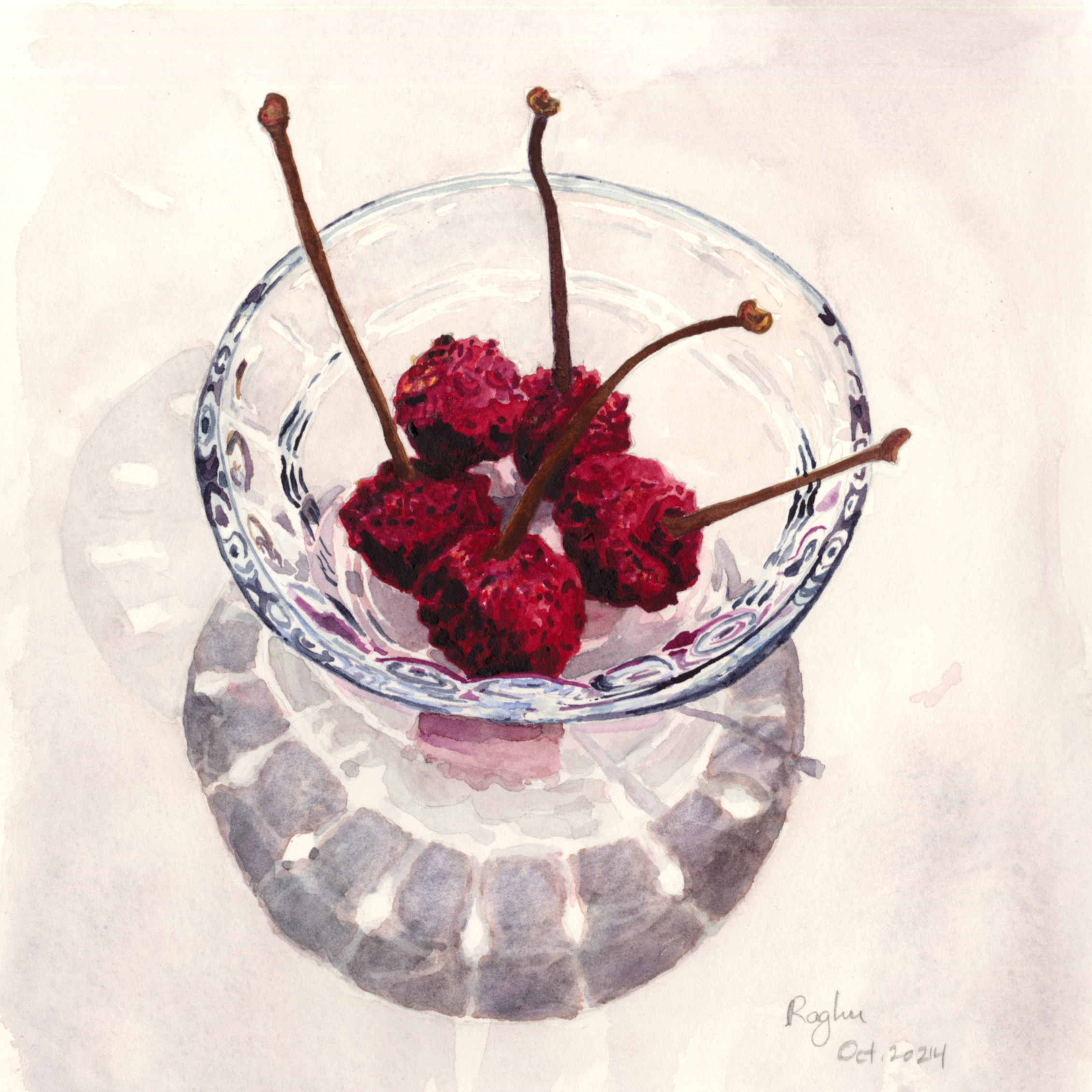
Who knew that the fruit of the Kousa Dogwood Tree is edible? Until about 2 weeks ago, when I spotted a colleague eating one, not me! There is a tree in front of the physics department building, from which I tried a fruit for the first time. These that I drew, however, are from a different location, overflowing with berries. They’re messy — one has to rip the tough skin, and the squishy soft interior has lots of large seeds. The taste when very ripe is like lychee, with a bit of mango mixed in. Like Oregon grape, though, I am likely in the minority who enjoy this. When picking some, I chatted with a passer-by who tried a berry, and said it was like slightly sweet mashed potatoes; he was not impressed.
Back to the painting: The shadows ended up too muddy, but it’s fun to paint glass. I traced a bit of the edges, and drew and painted the rest unassisted.
— Raghuveer Parthasarathy. October 21, 2024
 The Eighteenth Elephant