

This past term I taught my “Biophysics for non-science majors” course, actually called “The Physics of Life,” for the first time since 2018, and, more notably, for the first time since writing my pop-science book, So Simple a Beginning: How Four Physical Principles Shape Our Living World (blog post; Amazon) — published in 2022 (and now out in paperback!). The course and the book aren’t directly related, but teaching early versions of the course, and writing things for it, put me on the path towards the book. Now, appropriately, I used the book for the course, though it’s not written as a textbook. (There aren’t exercises, for example.) The course counts towards the University of Oregon’s general education science requirements, has no prerequisites, and is intended to be very accessible to students regardless of major. There were 46 students enrolled.
How did it go? In some ways well; in some ways poorly. I’ll start with the worst parts and some lessons we might draw from my problems. Then I’ll point out topics I taught for the first time, some of which were successes.
If you’re interested in teaching a class like this, I’m happy to share my materials, which include a set of about 200 multiple choice questions, homework assignments, descriptions of in-class activities, and more. Feel free to email!
The Physics of Lifelessness
Often during the term, my class session reminded me of this scene from the film Blow Up, with me being The Yardbirds and the class being excruciatingly lethargic. Stop before 2:00; I didn’t smash any guitars.
Routinely, it was hard to get engagement, questions, or discussion amid a general mood of apathy.
I don’t have a good explanation for why this was. Of course, ultimately it’s my own fault; part of the task of teaching these gen-ed courses is to motivate students, which always takes mental and physical effort. Since I teach these classes a lot, though, I can legitimately point out that it was more difficult and less satisfying than usual, and it’s hard to believe that I suddenly became significantly more inept. One issue may have been that some of the class material was new things I had never taught before, but the first half of the term contained mostly older topics and the dullness existed then as well. I heard similar complaints about a lack of engagement from other people teaching lower level courses, leading me to think that the concern is more general. It’s important not just because it makes teaching less pleasant, but because it worsens the experience for students themselves. There’s a lot to be gained from active learning — discussions, questions and answers, and figuring things out — but this fails if there isn’t a critical mass of engaged students.
Could one segregate the students who want to participate from those who want to be passive? Two of us are trying this out in general education classes next term, asking students to place themselves in different parts of the classroom. We’ll see what happens!
There were certainly students who were excited about the course (1:21 in the video), but I’ll return to this later — this is the negative part of the post, remember.
Student preparation
Someday I should write a post about how we, as a society, push students into higher education without acknowledging that it’s perfectly fine not to be passionate about learning or tolerant of sitting in classrooms. Today, however, is not that day.
Today I will note that completely separate from issues of motivation, goals, or one’s value as a human being is the issue of how well prepared one is for college courses. The University of Oregon is like many large, not-very-selective public universities. There are lots of phenomenally skilled students, as strong as the strongest at any “elite” university. (I am not exaggerating.) Many of these students are well prepared coming into college. The range of student preparation at the University of Oregon and similar places, however, is enormous. Those with poor preparation have astonishingly poor preparation. This range has always been large, but it has gotten notably larger in the past few years — perhaps it’s fallout from Covid-related school closures and the disasters of online learning, perhaps it’s a general erosion of accountability or the notion of standards in K-12 education that is setting students up for failure. Whatever the cause, the observation is a common topic of conversation among those of us who teach wide swathes of students. What do I mean by poor preparation? Others have noted an inability or unwillingness to read; I agree. There’s also a remarkable innumeracy among many students that transcends particular topics or skills. Being able to make numerical estimates is extremely powerful and rewarding, and it’s one of the aims of many of my courses — we spend a lot of time practicing and applying this. Here’s a boring and rather embarrassing question I asked on a quiz, which I thought was a throwaway to simply make sure people could multiply powers of 10:
A hippopotamus has a mass of about 1000 kg, and there are about 100,000 hippopotamuses on Earth. A pig has a mass of about 100 kg, and there are about 1 billion pigs on Earth. Fill in the blank: The total mass of all the pigs is about ____ × greater than the total mass of all the hippos.
Choices: 10, 102 ,1000, 105
The fraction of the class answering correctly: 51% . I was stunned. (You might ask: maybe students don’t know what a billion is? We had done examples involving “billions” before. Also, it’s college.) How to help those who are starting far behind the others, while also helping the rest realize their potential, and while not wasting students’ time or $12-$34k per year tuition, is a challenge.
Nonetheless, we carried on, and made our way through random walks and diffusing proteins, power-law scaling and biomechanics, and other topics.
Genetic Circuits
In the prior iterations of this course (2018 and earlier), we covered the components of living things, like DNA, proteins, and membranes; principles like random walks that help us understand microscopic motion and DNA packaging; and macroscopic issues of scaling — why big animals need disproportionately wide bones, for example, and why you can’t walk on water. These topics are all in my book, whose writing they helped motivate. (I used my book as a textbook for the course; it was available free as an e-book from the university library, which is the form that most students made use of.)
In the years I spent writing, I also realized that an exploration of biophysics should involve more: how genes assemble into circuits by which organisms can respond to stimuli and use feedback to form memories and clocks; physical mechanisms underlying how embryos form; our amazing abilities to read DNA sequences and even rewrite the genetic code, both of which are made possible by understanding the physical characteristics of biological materials. These are in the book (Chapters 4 and 7, and all of Part 3), and I put pieces of them in the course as well.
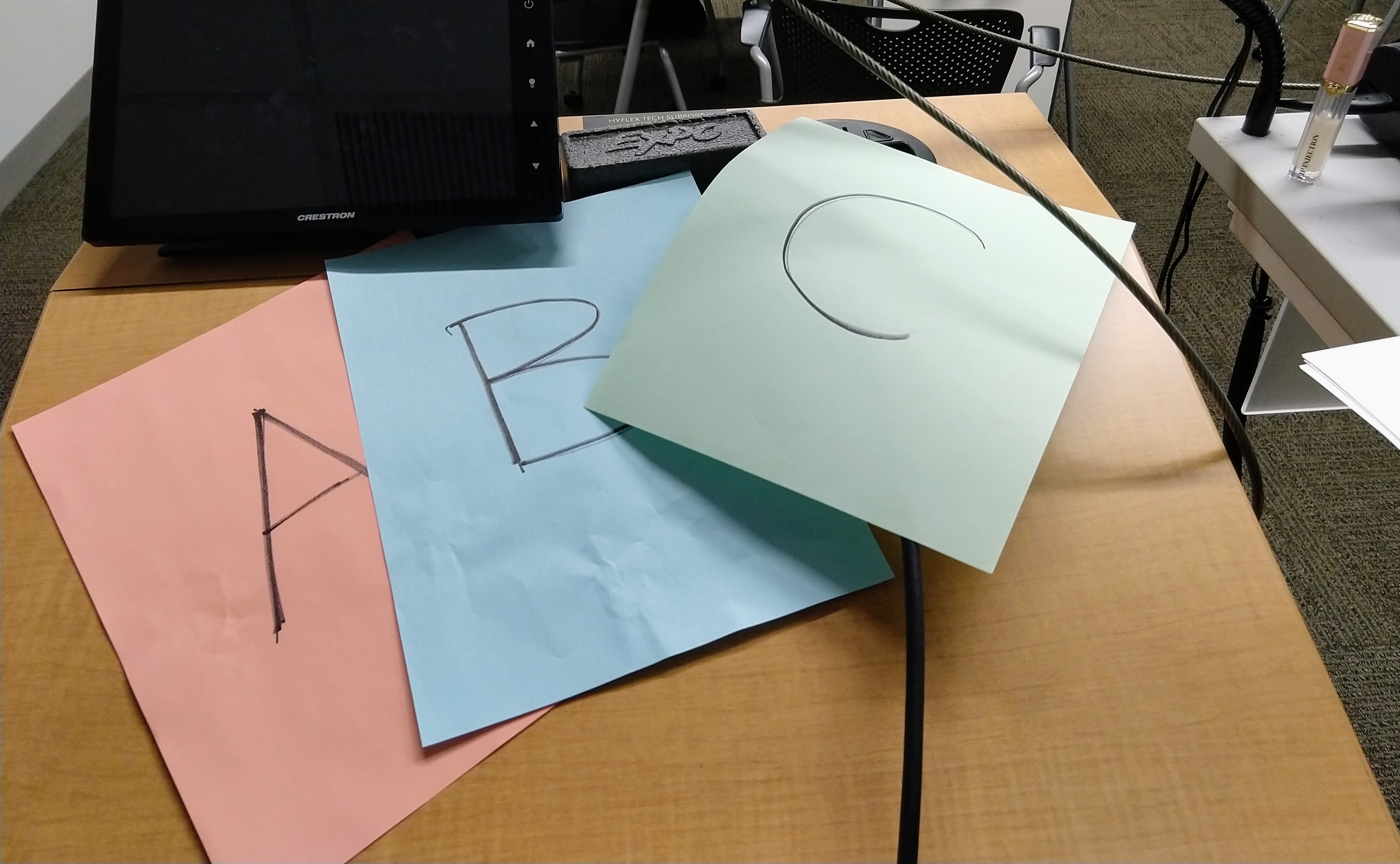
Genetic circuits were a highlight of the course. We covered classic topics like the lac operon — how bacteria can make a protein to digest lactose only if lactose is present, moving then to implementing the logic of making the protein only if lactose is present and glucose is absent. The fun part came from making an oscillator — specifically, the repressilator, in which three genes each encode the repressor for the next gene in a cyclic sequence. (In other words, A represses B, B represses C, and C represses A.) I made “A,” “B,” and “C” cards for three students, who stood up and raised their cards if they weren’t being repressed by the appropriate other gene; without instruction from me, this quickly and clearly led to oscillation of raising and lowering arms! Removing one of the genes (i.e. A represses B and B represses A), just as clearly, doesn’t give oscillations but rather a stable memory.
A few weeks later, coupling the oscillator — a row of students with waving arms — with a diffusing concentration gradient that stops the clock — me walking across the room — gives a spatially periodic pattern; this is the segmentation clock that gives us our segmented backbone.
These two activities were fun and effective. Perhaps next time I should incorporate physical activity into each class topic.
Reading and Writing Genomes
The topic of DNA sequencing went fairly well — students understood how properties like electrical charge underpinned the classic Sanger sequencing method, and we explored the more modern methods as well. (The existence of nanopore sequencing is truly mind-boggling.) We ended with CRISPR and gene editing; it’s amazing, and I end my graduate biophysics course with this also. There isn’t much to say here about physics other than to comment on electrical charges; I don’t want to go into DNA mechanics or binding probabilities. That’s fine, though; I expected this from the start.
In between DNA sequencing and CRISPR is a segment on genomes and traits that leads to socially important and contentious topics like embryo selection. In some ways this went well; we discussed that many important traits are polygenic and what genomic “prediction” means in this context. I briefly went over the history of in vitro fertilization (IVF), now commonplace but just a few decades ago controversial to an extent that now seems bizarre. Would children born of IVF love their parents was not an obvious question, apparently (Chapter 14). The historical discussion parallels current discussions of embryo selection, though the latter seem more sedate. By a nice coincidence, a video conversation between physicist (and my former colleague) Steve Hsu and Elizabeth Carr, the first “test tube baby” born in the US, came out a few weeks earlier, and I played a few minutes of it in class. All this went well, but what I failed to do is come up with exercises that illuminate the concepts of randomness and probability that relate to polygenic traits and the predictability of embryo selection. One could tie this back to random walks and other topics explored earlier, but I didn’t get around to coming up with anything concrete. In part this was because the end of the term became very busy; in part I admit that the lethargy of the class dampened my enthusiasm to work on it; and in part, I don’t have any excuse.
Conclusions
Despite its challenges, I consider this a worthwhile course. As described above, I think there’s a fair fraction of the class I didn’t reach. On the plus side, some people really liked it! More students than usual came up after the final exam and told me how much they liked the course. At office hours, there were excellent conversations. The term gave me a lot to think about regarding teaching, some of which I can even put to use in next term’s course, the general-education “Physics of Solar and Renewable Energy.”
Today’s illustration
“Anacampseros”, from a photograph in “A Field Guide To Succulents” by Misa Matsuyama, which I picked up from the new book shelf at our Art and Design Library.
— Raghuveer Parthasarathy. March 29, 2024
 The Eighteenth Elephant
Lack of preparation leads to a lack of engagement, which leads to disillusionment. After teaching dentistry for fifty years, I experienced intermittent lethargy in my students, and it did have short-lived, deleterious effects on my own enthusiasm. But every class session was another opportunity to innovate and introduce new materials and techniques. But even when a new idea worked very well, within two years it was no longer viable. The half-life of creative ideas in education is about 1.5 years. Fortunately, hope springs eternal.
Your comments about student apathy and poor preparation plague all physics teachers, and I don’t know anyone who has solved the problem. It is probably THE central issue of higher education.
I have a Master’s in a science field w/ calculus, etc, but the answer to your hippo question wasn’t instantly obvious to me. I had to bother the math in my head for each animal. It takes only an instant, but I do have to explicitly perform the ops to get the right answer. So I wonder if lazyness was part of the problem – people didn’t bother to go through that process and just guessed.
Recently I’ve been listening to one of those “Great Lecture” series by the economist Timothy Taylor. The last lecture I listened to was about “information cascades” and how people substitute “conventional wisdom” for actually thinking through a problem to get the answer. I wonder if, on a problem that students may not instantly understand like the hippo problem, somehow they default to a brain circuit that uses a social (e.g., conventional wisdom), rather than an anayltical (e.g., taking the instant necessary to work out the problem), system to get the answer. It seems possible that a class with no prereqs could have a high proportion of people that are in the habit of “social sourcing” their answers. Of course in this case there’s no “conventional wisdom” answer, so once they switch to the “social” answer circuit, they are forced to guess. Wonder if you make them write out the problem if that would have an effect.
Speculative I guess but I think a lot of people are in the habit of “social sourcing” the answers to problems, rather than working them out from what they know. It takes a lot less effort, even if it leads to the wrong answer some proportion fo the time. If that’s true then part of the challenge of teaching a science course to the masses is breaking that habbit and “herding” them back into doing the work of thinking. 🙂
Great blog, thanks for sharing your insights.