

Salary negotiations are currently underway at the University of Oregon (UO) between the faculty union and the administration. If this sounds familiar: graduate student salary negotiations concluded earlier this year. Two weeks ago, the administration emailed a description of its perspective on faculty pay that included some interesting data and graphs, such as the amount of funding the University of Oregon gets from the state of Oregon compared to other public universities that are members of the American Association of Universities (AAU), a group of research-active schools. Here is the graph:
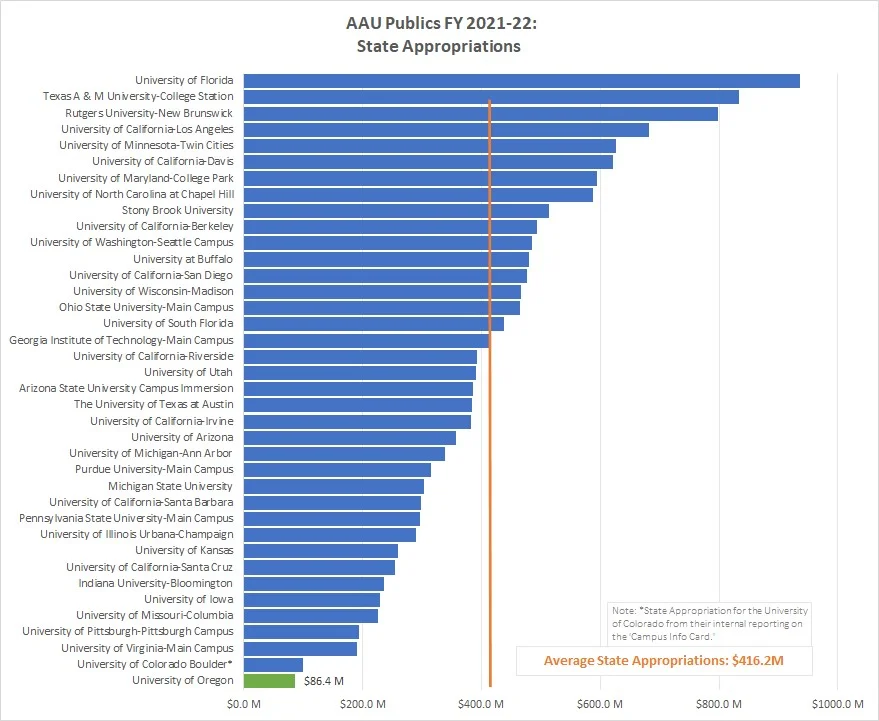
It is shocking, though irrelevant. It’s shocking because Oregon looks so miserly compared to other states, including several states Oregonians tend to scorn as being anti-education. It’s irrelevant because the overall funds available might dictate how many faculty one can hire, but not how much to pay each of them. If I’m buying granola bars, I can’t ask the store to lower the price because I don’t get paid much; I buy fewer granola bars.
This graph and its context of salary negotiations lead to all sorts of interesting data I’d like to see plotted, like state funding per student, or the salary of university presidents at these institutions. I’ll get to these shortly.
First, let’s look at the funding data (“state appropriations”) itself. I started out simply reading (and digitizing) the budget numbers from an image of the above graph, but I decided to poke around a bit on my own to verify the information. This was painful. These data are not readily available, and for several AAU public universities I couldn’t find numbers at all. For all of the University of California campuses, for example, I could only find the system-wide total appropriation. There were a good number of AAU public universities, though, 27 out of 38, for which I was able to find the state funding amounts. In many cases these matched the numbers from the UO graph. In three cases, the UO-stated value was smaller than the value I found by over 20%; Stony Brook, U. Wisconsin at Madison, and U. Virginia have higher state appropriations than the graph above indicates. In 6 cases, the number I found was considerably smaller than what UO stated, especially on the high end of the scale — Texas A&M for example getting $511M from Texas rather than $834M. I will emphasize that figuring out these numbers is challenging. One issue is the year — UO’s graph uses 2021-22 data, and I took the most recent I could find, mostly 2023. Funding levels fluctuate. UO’s funding from the state of Oregon, in fact, increased significantly from $86.4M, as depicted in the above graph, to $115.5M in 2023. Moreover, there a lot of ambiguity in what counts as a state contribution — Ohio State’s for example includes “health system instructional funds”. Is this money available for normal student education? I encourage anybody reading this to email me or comment with better numbers, more information, details, or tips. I list all these numbers and sources in this Excel file:
Here’s the graph of state appropriations based on the UO data (green) and, when possible, based on my data (blue):
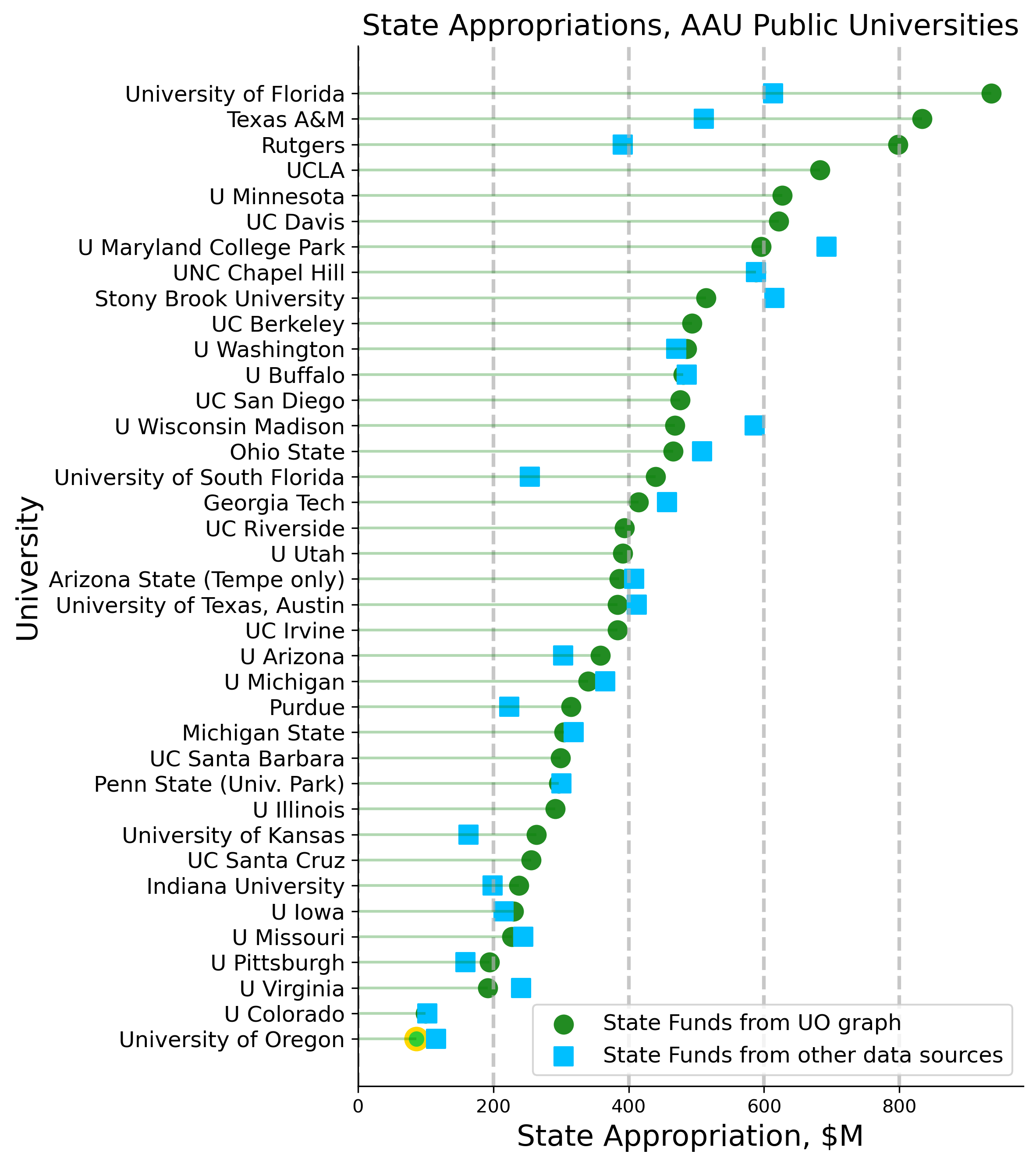
It’s worth noting a broader point that U.S. public universities in general are primarily funded by tuition, not by the state, a fact that many people, including many faculty, seem unaware of.
You might be wondering how large the state appropriation per student is — the more important number for a university. The AAU Publics span a large range of sizes. Texas A&M, for example, has 60,000 undergraduate students, and the University of Virginia has fewer than 17,000. UO has about 20,000. We can calculate the state funding per student, but the more relevant number is the state funding per state resident student, i.e. omitting the out-of-state students whose tab the local government need not feel obliged to consider. I looked up all of these — I’ve done this before, and the values are in the spreadsheet I posted above. The following shows the state appropriations, using the UO-supplied values (green) or the numbers I found (blue), per state-resident undergraduate student:

UO fares poorly, but Oregon is not the most miserly of the bunch with respect to its “flagship” university, being #36 out of 38 (based on UO appropriation data), or #30 out of 38 (based on my data). Congratulations, Colorado! And non-sarcastic congratulations to North Carolina, which spends $35,000 per year for each student attending UNC Chapel Hill. (I’m sure my favorite Tar Heel knows this!)
Is our university president poorly paid?
Let’s look at the salaries of the public AAU university presidents. Is ours ($725,000), commensurate with our low state funding? No:

I tabulated these salary values by searching various websites; I provide all the numbers and sources in the above-linked spreadsheets. There are several caveats to the data. They don’t count the free housing and other perks university presidents get. They also don’t count bonuses, for example the $300,000 that the University of South Florida’s president got recently on top of a $655,000 salary, and “deferred salary,” which appears to be some strange scheme for getting money later and having one’s current salary be lower. In any case, we are not at the bottom. (Update, Sept. 1: The Chronicle of Higher Education just posted a list of public university president salaries, here. Many schools, however, including UO, “had not submitted compensation data.”)
This leads to the last missing graph. One might expect that a large university is more complex and therefore more difficult to run, and so the salary of a larger university’s president should be larger than that of a smaller one. This wouldn’t hold for faculty — individual class size isn’t twice as large when overall enrollment is twice as large; there are just more classes.
Let’s plot the president’s salary per undergraduate student for the AAU publics. (Of course, the proper scaling need not be linear in student number.) We’ll consider total undergraduate enrollment; the residents and non-resident take the same amount of supervision! Here’s the graph;

We’re not near the bottom. In fact, we’re near the top: #8 out of 38! Purdue’s president is the lowest (or, most sensibly) paid, and I’ll also note that Purdue has done a wonderful job freezing tuition rather than following every other school’s policy of sustained, exorbitant increases. But that’s another topic…
One could therefore make a solid case that the University of Oregon’s president is overpaid, relative to our state funding, or especially relative to the scale of the university. Of course, this isn’t the way presidential salaries are set. Moreover, this is irrelevant to UO faculty salary negotiations. But, if the administration wishes to emphasize the (poor) argument is that UO doesn’t have much money and so we can’t have the salary of our peers, or that “The cost of living in Eugene is lower than average at our AAU public peers” justifies low faculty salaries (from an email from our provost), I’d be more likely to buy these claims if they applied to administrative salaries as well. From what I can tell, they do not.
There are frustrating parts of the union proposals as well — I strongly dislike their focus on across-the-board raises rather than merit-based raises — but especially in recent, fascinating, data-driven statements, their arguments are clearer. At least, they haven’t driven me to spend hours making my own graphs.
Today’s illustration
Another painting from a photograph by William Eggleston, from a book of Eggleston’s photographs, as in the last post. I did this one quickly, tracing the general shape and not thinking too much about the rest. It’s not good, but that’s today’s illustration!
— Raghuveer Parthasarathy. August 31, 2024
 The Eighteenth Elephant
We know where the money’s going at the flagship campus of the University of Nevada: https://statmodeling.stat.columbia.edu/2024/02/12/torment-executioners-in-reno-nevada/
and at the flagship campus of the University of California: https://statmodeling.stat.columbia.edu/2020/03/24/why-we-sleep-a-tale-of-institutional-failure/ and https://statmodeling.stat.columbia.edu/2009/05/12/yoo_again/
Considering those alternatives, spending it on a university president who blows it all on some mixture of office renovations and coke isn’t so bad–at least he’s not actively damaging the university’s reputation for scholarship!
The University of Nevada VPR saga is still so mind-boggling.
Vice Presidents for Research are paid a lot. I still don’t understand what they actually do, and what the qualifications are. It would be interesting to chart how the salary for this position has changed over time.
About other positions, you might like the comment I wrote about our new provost salary / perks here: https://uomatters.com/2024/06/provost-chris-long-is-paid-540k-per-year-plus-130k-start-up-alcohol-budget.html (scroll to near the bottom).
Raghu:
I checked that out and posted a comment. Which was there for awhile, but now it seems it was taken down. I guess the UOMatters blogger didn’t like my comment, maybe because it wasn’t Oregon-focused? The last time I was in Oregon was when biking from Vancouver to San Francisco, and our route didn’t take me past Corvallis anyway.
Your comment is still there, Andrew! The UOMatters site has weird cache problems; I always hit “reload” at least once to make sure it’s loading comments (and main posts) properly. I know the person who runs it — he’d never take down a comment unless patently illegal.
More importantly: we’re in Eugene! (Oregon State is in Corvallis.)
OK, that’s good to hear regarding the comment. I was impressed by the UOMatters blog and I wrote a post about it, should appear in January or so.
Also, yeah, the Corvallis thing was a joke. I’ve never been to Eugene either, though.
The UO Matters blog is great. The person who runs it (Econ prof. Bill Harbaugh) retired last year so it’s now updated much less often, but it has been an excellent source of information and discussion, even when a bit inflammatory.
You should visit Eugene some time — it’s a great place for biking! I don’t think we have any Jamaican beef patties, though. (Admittedly, being vegetarian, I haven’t actually looked into this.)
Hi Raghu
Recently I was having a zoom conversation with my son (Not quite an ignoramus, he graduated BS in mat egr +MBA) and he saw my calendar flash on the screen with all sorts of color blocks. So he asked – Dad what do you do all day? I answered – oh, you know there is meeting after meeting to solve issues, it keeps me very busy.
His response (with a serious face) – Dad you were so much more productive when you were a faculty!
Alas, when he was a young boy, he would, along with his mom, bring us dinner at the lab when my students and I were pulling an all nighter. He would hang out for a while until it was time to go. Perhaps he is not wrong from his perspective. In fact, I always remind myself, I am a faculty first and an administrator second. A little dose of humility from one’s own child is always good.
As a highly research active faculty I thought you would be better informed. I welcome you to come spend an hour or two or better yet a day or two with me. We can call it bring your researcher to work day. However, come at your own risk, if it kills a few grey cells when you attend those meetings, I am not liable.
If you would like to connect you know how to reach me.
best
AR: Thank you for commenting! Let me first point out that I am sad to hear that you’ll soon be leaving UO. I’m not just being polite — this has come up in several recent conversations following your announcement, and everyone I know, myself included, has been especially impressed by how you’ve handled the chaos of the past year — capricious funding cancellations, bureaucratic persecution of international students, etc. Your actions and communications have been excellent. The past year — note that my post is almost 12 months old — is one in which it is quite clear that there are a lot of items on a VPR’s agenda.
All that said, it is the case, as I wrote, that under usual circumstances I do not know what occupies a VPR’s day, at a level of detail finer than “meetings.” Even meetings is a category that spans many possibilities. I met with undergraduate and graduate students yesterday for more than 2 hours, which involved debugging code with them, planning experiments, and troubleshooting experimental problems. I have been at increasingly many administrative meetings that seem to have 3x as many attendees as necessary and that consist largely of statements about past meetings, presentation of material that would be more easily absorbed as text, and that ramble along without reaching any conclusions. There is undoubtedly a whole spectrum in between. If our schedules permit it, I’d be happy to come chat for an hour and dig into what exactly being a VPR is, what your meetings are about, and what decisions are demanded. (I really am curious about the details, and I don’t doubt your dedication!)
More broadly, since I think you object to the general tone of my post, I think the increasing distance between administration and faculty, reflected in salaries as well as career paths, amount of interaction, etc., is a major concern. I’m sure the position of VPR, and other administrative positions, have gotten more complex over the past two decades. Faculty positions have also gotten more complex and more difficult, but the arguments that have led to skyrocketing administrative salaries somehow do not apply to faculty. Again, this isn’t a criticism of you — you should take what’s offered, and you’re doing good things — but of the system as a whole. The argument of market salaries for administrators is a fine one in theory, but in practice there is zero effort put into seeing if lower salaries would reduce quality. In fact, clear lapses of quality (e.g. a former VPR I won’t name) are rewarded by moves to other positions, often more highly paid — a constant flux of administrators between institutions. I have lost track of how many presidents UO has had during my 19 years here. (At least 6, but I think I’m forgetting some.)
Finally, it is odd to be writing this now, as UO is planning its suicide due to bizarre employment decisions. (Not related to you or your office.) My trust in the UO administration is lower than it has ever been, and lots of people here share this view. But that’s a different story; I’ll probably send you an email.
I’m a bit nervous making this suggestion, but what about ranking faculty salaries by teaching workload – e.g. faculty per student?
I don’t like this since it will devalue teaching more advanced topics unless different levels of students are counted differently. As fond as I am of 100-level courses, we’d be a terrible university if we didn’t teach small 400-level courses! At the level of departments it makes more sense, though again only if we give different sorts of weight to service-course students, majors, etc., which the university (sort of) does already.
This reminds me that I used to think departments had much more autonomy than they do, about things like budgets, and also policies.