
Each of us has a genome of about 3 billion DNA nucleotides — a sequence of 3 billion As, Cs, Gs, and Ts. Knowing what this sequence is, whether our own sequence or that of a bacterium, a barley plant, a baboon, or anything else, tells us about the repertoire of tools its genome encodes, which can reveal such characteristics as susceptibility to disease or evolutionary relatedness. In 1982, we had read the 48,000 nucleotide genome of a virus. The first human genome sequence was essentially complete in 2001, after about a decade of work. How much did it cost? I asked students (graduate and undergraduate) in my biophysics class this past term to guess how much it cost. You, too, can guess…
The answer: $3 billion. (For scale, CERN’s Large Hadron Collider cost about $5 billion.) Now, in 2023, how much does it cost to sequence a human genome? Less than $1000! I showed the class the graph below, the cost of sequencing a 3-billion nucleotide genome over the past few decades:

The drop in cost — a factor of over 100,000 in 20 years, and a million over 30 years — is one of the most stunning illustrations of progress in modern science and technology. How did this happen?
I spend a while on this topic in my pop-science biophysics book — it gets a whole chapter, “How We Read DNA.” Since this series of blog posts (#1, #17) focuses on questions rather than answers, I’ll just briefly note that the saga of DNA sequencing involves a parade of dazzling inventions, all of which share a common theme that isn’t widely appreciated: they were made possible by taking seriously the notion of DNA as a tangible physical object, with material properties like electrical charge, that, if we could understand and manipulate them, would reveal its secrets.
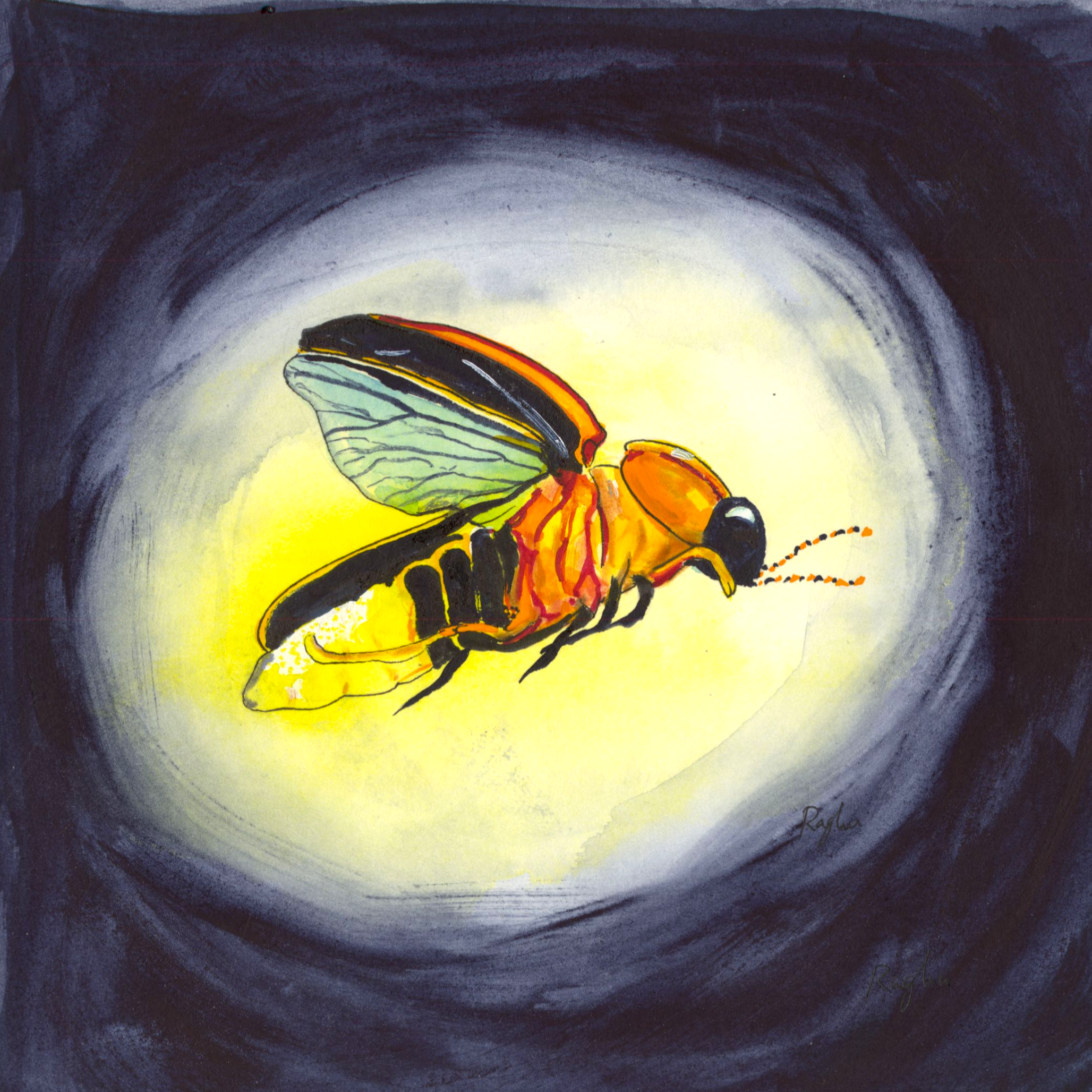
One method made use of the fact that a single proton is released as a nucleotide is added to a growing DNA strand, and this proton’s electric field can influence current flow in a transistor, allowing an electrical readout. (This is “454 sequencing,” commercialized in 2010 and since made obsolete by new technologies.) Another no longer current method used light emission as DNA strands grow, provided by a firefly-derived enzyme, hence today’s illustration. Another currently popular method threads DNA through pores, measuring subtle variations in electrical current through the pores due to the different sizes of the four different nucleotides. (This is nanopore sequencing; a neat video.) And there’s more!
It’s fun to teach about DNA sequencing, even if only for 45 minutes at the end of a term, and to write a chapter illustrating its amazing methods and its history. (Usual book links: My description, the publisher, Amazon.) Reading genomes isn’t commonly thought of as biophysics — I don’t know why; perhaps because of a general lack of awareness of technology among academics. Nonetheless, it highlights very well the intersection of physical principles and biological investigation, with issues of economics and industry mixed in as well!
Today’s illustration
A firefly; watercolor and marker. Based on a photo here.
— Raghuveer Parthasarathy December 15, 2023
 The Eighteenth Elephant